Interview with Mikel Zaldua, General Director of Saspi
The fasteners and boltmakers sector is experiencing a moment of transformation driven by digitalization, industrial connectivity, and automation. In this context, at Saspi, we have reinforced our commitment to innovation and personalized service, moving forward hand-in-hand with our clients to jointly face the new challenges of the industry.
In this interview, we analyze the changes in the sector during 2025, the year’s learnings, and the challenges for 2026:
Quick Adaptation to Change: Innovation and Emerging Technologies
1. What transformations has the boltmaker machinery sector undergone during 2026?
During 2026, the sector has accelerated its transition towards total digitalization. Machine-to-machine connectivity, real-time data analysis, and advanced automation have become market standards. This has driven companies to seek more flexible, intelligent machinery capable of integrating into highly digitized production environments.
2. Technological adoption is constant in the sector. How does Saspi ensure it incorporates the most relevant innovations and stays at the forefront?
We participate in international trade fairs, collaborate with other companies, and provide continuous training for our team. This allows us to identify emerging trends and apply them quickly. Our R&D department actively works on prototypes and improvements that integrate new technologies without compromising Saspi’s characteristic reliability.
3. What emerging technologies—especially in artificial intelligence and automation—represent a strategic opportunity for Saspi in the coming years?
Solutions based on artificial intelligence will be essential in the next generation of machinery. AI will allow us to implement predictive systems, autonomously optimize production parameters, and reduce downtime. Collaborative automation and self-calibration systems will also make a significant difference in operational efficiency.
New Machines and Technology: Connectivity and Data Analysis
4. Saspi has presented new machines this year. What are the main improvements or innovations they incorporate compared to previous models?
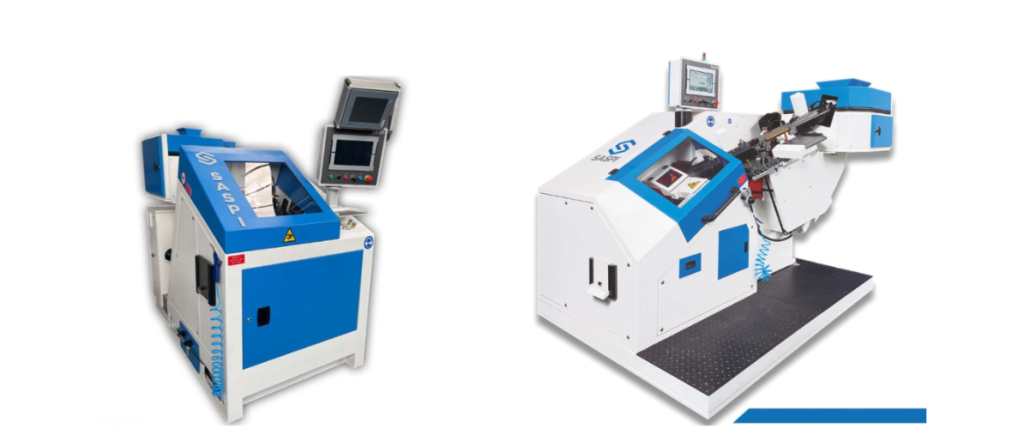
This year, during the Fastener Fair Global 2025, we presented two of our most recent and advanced solutions for the sector: GV2 Evo and MPA14CL, both designed to respond to the most demanding production environments in the fasteners industry.
The GV2 Evo represents the new generation of thread rolling machines, with unprecedented precision and versatility. Its fully motorized configuration allows for the fastest changeovers in the sector, optimizing productivity. It is prepared for intelligent manufacturing thanks to its total connectivity for remote monitoring and data analysis, making it a key machine for highly digitized plants.
For its part, the MPA14CL is a cam-less pointer designed for high-precision second operations, capable of performing facing, pointing, drilling, and punching in a single machine. Its combination of speed, accuracy, and flexibility positions it as a comprehensive solution for advanced fastener processes.
5. How do connectivity and data analysis influence the operation of the machines?
Connectivity plays a fundamental role. In the case of the GV2 Evo, its architecture prepared for intelligent manufacturing allows for:
The advanced connectivity of GV2evo enables its total integration into smart manufacturing environments. With the capacity for remote monitoring and real-time data analysis, this machine is designed for data-driven production.
6. In what way do these new machines help customers increase productivity and reduce operating costs?
The GV2 Evo stands out for its ability to perform quick changeovers, which minimizes downtime and increases overall efficiency. Its advanced connectivity allows deviations to be detected before they affect production, preventing rejects and optimizing resources.
The MPA14CL, thanks to its versatile design, allows multiple operations to be performed on a single machine (facing, pointing, drilling, punching). This reduces the need for additional equipment, shortens manipulation between processes, and improves production flow. Its cam-less technology reduces maintenance and decreases the probability of breakdowns.
Our Values: Closeness and Personalized Service
7. Despite the modernization and digitalization process, how does Saspi ensure that closeness and personalized attention remain a fundamental pillar?
Technology allows us to be more efficient, but it never replaces the human relationship. We maintain direct contact with our clients, offering personalized support from design to installation and after-sales service. Constant communication is the foundation of our long-term loyalty.
8. What new initiatives is Saspi implementing to strengthen relationships with current customers and reach new markets?
- Reinforcement of International Presence at Trade Fairs and Events: We are committed to active participation in key sector trade fairs and events. This allows us to maintain direct contact with our current customers, listen to their needs firsthand, and simultaneously open doors to new global markets.
- Driving Strategic Collaborations: Another fundamental axis is the generation of strategic collaborations with companies in the sector. These alliances allow us to expand capabilities, create synergies, and offer more complete and competitive solutions.
- Expansion and Diffusion on Social Networks: We are also actively present on professional social networks like LinkedIn. We use this platform to reach new markets and customers, and to disseminate Saspi’s latest news and developments to a broader, digital audience.
Learnings and Future Challenges
9. What are the most important learnings Saspi has gained from the challenges faced during this 2025?
The year 2025 has been marked by the acceleration of digital transformation and a high level of demand in the supply chain. The main learnings have been:
- Flexibility as a Critical Value: We have learned that the capacity for rapid adaptation (both in machine design and internal processes) is fundamental. Machinery must be flexible enough to adjust to the constant changes in our customers’ demand, something we have embodied in machines like the GV2 Evo with its motorized quick changeovers.
- Data is the New Asset: It has been confirmed that connectivity and real-time data analysis are the key to efficiency, not only for production but also for predictive after-sales service. This has pushed us to reinforce our architecture for intelligent manufacturing.
10. What challenges does Saspi anticipate in the sector for 2026 and how are you preparing to face them?
For 2026, we anticipate challenges mainly centered in three areas, and we are actively preparing to address them:
- Challenge: Total Integration of AI and Cybersecurity: The next phase of digitalization will involve the deep integration of AI for predictive maintenance and autonomous optimization. This requires reinforcing the cybersecurity of our machines and data management systems. Our R&D department is focusing on secure plug-and-play solutions that guarantee the protection of customer information.
- Challenge: Sustainability and Energy Efficiency: Regulatory pressure and market awareness demand more energy-efficient machinery. We are dedicating resources to optimizing the consumption of our new ranges and designing manufacturing processes that minimize environmental impact, responding to a growing demand for more sustainable solutions.
- Challenge: Specialized Technical Talent Gap: With the sophistication of machinery, the need for highly qualified technicians and operators increases. At Saspi, we are investing in continuous training for our team and developing intuitive user interfaces that simplify the operation of our advanced machines, to facilitate the transition to new technology.